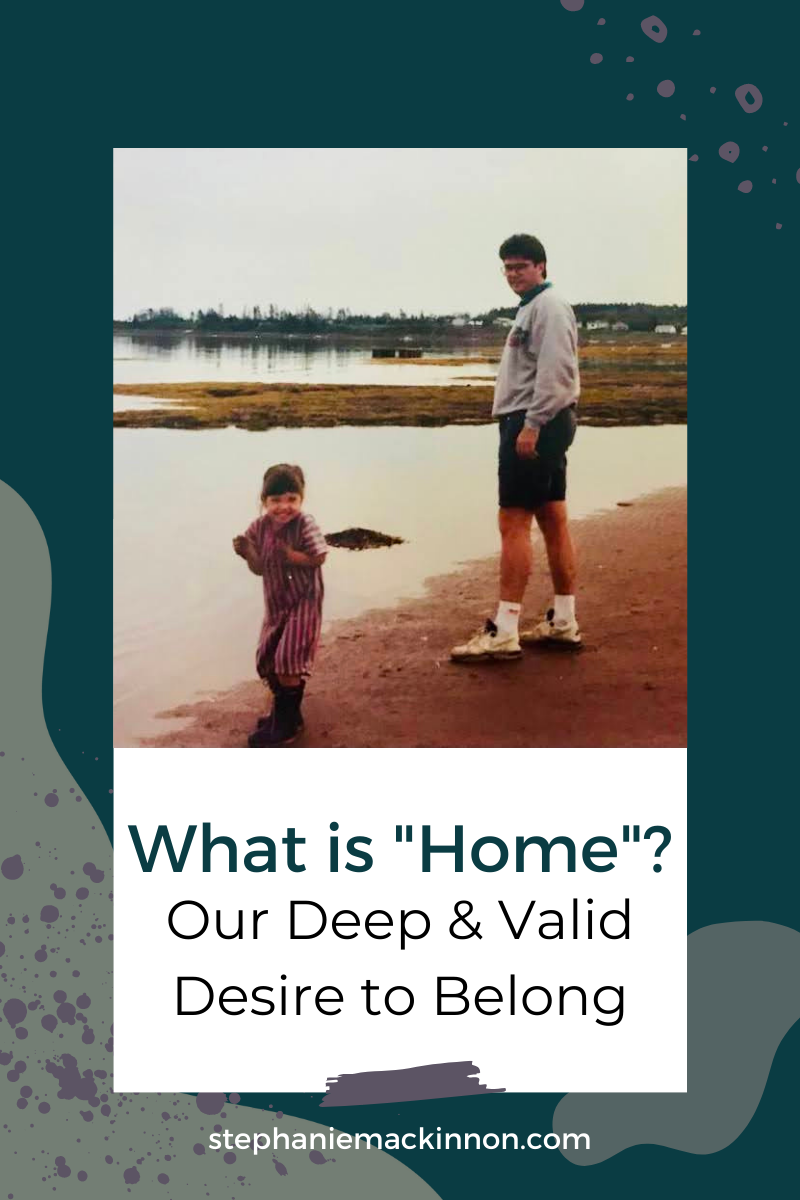
What is “Home”? | Our Deep & Valid Desire to Belong
Certain moments in our lives provoke an extra bit of reflection. There are the natural ones when the world tells us we are supposed to pause, look back at how far we have come, and consider where we want to go next: you know, like the transition to a new calendar year or a big birthday.
But at this moment, I am feeling my reflective tendencies heightened even further as I cautiously count down the days to my return to Nova Scotia. The biggest questions on my mind are: What is home? What makes something feel like a home? Is it something we can foster?
This is not the first time I have considered these questions. Born to parents, who always wanted to take advantage of the opportunities available to them, I got used to moving around as a kid. Starting in new schools and making new friends became a practiced skill, often supported by the involvement in sports. It is an approach to life I have carried on in my adult life and to date have roughly called 19 places “home”. Yet throughout it all, Nova Scotia has always felt like “home”.
When I miss “home”, I think of Nova Scotia, and am immediately flooded with memories, some from my childhood building sandcastles to withstand the oncoming tides, the smell of a BBQ, conversations on hot humid evenings where all sense of time is lost and fits of laughter have created stitches in our stomachs as we lose our breath. I also remember how my mom packs the best beach snacks, how I am happiest floating in the ocean. My mind also wonders to the extended family I always had in the rugby community, with countless hours spent on pitches around the province. The memories feel warm, they make me smile. Even just bringing them to mind, I can feel my body relaxing, that I am overall much more at ease.
Like many, this last year and a half has meant that I have been away from my family for longer than I ever have before. Bearing witness to others’ reunions on social media has been emotional, to say the least. It’s like witnessing and being invited in, to share in the deep, full-body sigh of relief that accompanies the reunions. For those, who have yet to, or are still not sure when they will be able to, I see you, and I am sending you so much love.
Memories Can Play Tricks
While this is the longest I have ever been apart from my family, I have left and returned before. I am familiar with how a return can be super disorienting, as our memories don’t always match up with the realities we meet. There are two ways I find this happens.
First, after being gone for some time, we have changed (change is inevitable), but we forget that the places we have missed, those spots and people we have longed for have changed too. While beautiful in SO MANY WAYS, returning ‘home’ can also feel super jarring when our memory of a place or a person, frozen in time, doesn’t match what we are met with.
Second, with time, we tend to round out the edges, to simplify our memories. Often this simplifying is also a wee bit of romanticizing. In other words, when we deeply miss something or someone, our memories highlight all of the good things and push the challenges to the back of our minds.
A prime example of romanticizing memories (and to be frank, privilege) is how mismatched my idyllic memories are with the lived realities for many in Nova Scotia. The last few years have shown that the province has deeply seeded systemic racism and inequality. For those unfamiliar with these realities, they have shown their ugly face in many recent events, and disproportionately impacted African Nova Scotians and Mi'kmaq communities. Notably, how the Department of Fisheries and Oceans has disregarded constitutional rights and treated an Indigenous Fishery with deplorable racism or how the City of Halifax, only last week criminalized homelessness in a brutal example of police violence. Elliot Smith also created an incredible documentary on Netflix, titled There’s Something in The Water, that further highlights the experiences of environmental racism in Nova Scotia.
I am aware that the immense privileges I have, that shelter me from these lived experiences, and allow me to misremember/ idealize Nova Scotia. I am grateful for the work those on the ground are doing, Game Changers 902, amoungst many others and am hopeful that there can be a future where everyone who lives in the province can feel safe, at ease, and a deep sense of belonging.
SO WHAT MAKES A HOME?
So if our memories cannot always be reliable, what makes us feel like we're at home?
While difficult to describe, the feeling of home that washes over us it’s unmistakable. I find it is often accompanied by a sense of relaxation, a relief, maybe even comfort and ease.
I believe that any number of things can provoke this feeling for us. In each place I have lived that has come to feel like home, there has always been a landmark when, after being away, I realize “I am almost home”. I distinctly remember the first time I got this feeling while looking out the window on the train to the Westport, and spotting Croagh Patrick at dusk, my whole body relax as I registered “I am almost home”. It’s like my body knew before my mind could catch up, that this was a place I could be comfortable, at ease, and myself. Even as I write this, other landmarks that have had a similar impact quickly returned to me: The Red Barn in Barneys River, when I was studying in Antigonish, or crossing the bridge coming into Halifax.
I associate these feelings of ‘home’ when I am by the ocean, walking on the sand, or floating in the sea. There is something about it that has me feeling both connected and at ease. I imagine those who grew up next to the mountains have a similar association, but I do feel that my lifelong relationship with the sea, and its current proximity has supported this wonderful corner of the world to feel like home a lot quicker.
I also think that we can feel at home in the company of certain people, that it is the relationship, rather than a physical space, that fosters the feelings of home. I feel so incredibly fortunate to have old friends and new ones whose company elicits the feelings of ease and comfort in being myself.
TWINKLE LIGHTS
Bréne Brown uses the beautiful analogy of twinkle lights strung together to create a soft, warm, cozy atmosphere. She compares this to building trust in relationships (friendships included!). In the analogy, each light is turned on by a shared moment of vulnerability that has been received with empathy. She explains that when we feel safe to share little bits of vulnerability with someone new, and they receive it with empathy or return the gesture by sharing a little bit of vulnerability themselves, they build on one another. Over time these moments foster the types of connections we crave and a real sense of trust.
What feels right to share in any given moment will be unique to those in the conversation. It is interesting to note that what feels vulnerable or scary to us is often perceived by others as courageous or is met with a sense of relief at the honesty. Each light (or little share) feels like a safe way to test out new spaces, to see who is worthy of holding what you are going to share, who is going to receive it with care. The more lights that you have on together already, the easier it is to turn on another.
I share this because I think that the friendships I feel so grateful to have fostered in Westport are part and parcel of why this place feels so much like home. I feel so fortunate to have been welcomed and recieved with such care, with such empathy and with such openness. Over the last three years many conversations, with little lights turning on, have increasingly fostered a sense of connection, comfort, belonging and ease. It takes time, and it can sometimes be scary,(especially with the first few lights!) but, I think it is so worth trying. I also share this, because I think it is important to know the power you hold on the receiving end to support someone to feel comfortable and included, little gestures have made a really big difference for me.
I also think that when the spaces and people that make us feel at home are not available, this is when we turn to the comfort of our (sometimes distorted) memories.
IT CAN BE TOUGH
While some naturally fall into a space of feeling at home, for others we need to work on it, intentionally and with patience. I believe this can be true both when you are living in a new place, and when you have stayed in the same physical space.
It is so valid to feel isolated, lonely and scared. When I have lived in new places and felt that way, I took great solace in the reminder that there are billions of people in the world, and there is most certainly someone feeling the same way at that moment. People fear talking about these things for any number of valid reasons, but one that I know to be true is not wanting to scare others off with big feelings. Know that you are not as alone as you might think.
Just because you have always lived somewhere doesn’t mean it is easy to feel at home there either. Perhaps you have just started to feel comfortable with who you are, and the identity you previously lived within, the way “people know you” feels like a box you’re trapped within, expectations that are challenging to break free from. That is so fair, but I believe in you!
To be honest, this time around, I have found it easier to be vulnerable, to lean into the person I want to become, in a space that was void of expectations of me, in a place where I feel free from the labels or weight of a shared history. I feel grateful to have had this space, and share this only to reiterate that these experiences are so unique, and being in the same location, or finding a new one, neither is inherently better; both provide opportunities and challenges.
Feeling meaningfully connected to a community, or fostering a stronger sense of home, is an area a few of my clients have sought to work on in our coaching series. Many approach the subject with apprehension, unsure of whether they want to admit that they do not feel connected in the way that they would like to. I get this, admitting that we are craving connection can feel like a catch 22. This was one of the primary reasons I wanted to write this piece, to reiterate to all that this desire is SO valid. And hopefully, in sharing my experience, make explicit some of the work that actually goes into making it happen.
If you are feeling lonely, I encourage you to tap back into the things that bring you the feelings of home and belonging you crave. In other words:
What are the spaces you feel most at home? At ease? Yourself?
How can you foster that for yourself?
Are there opportunities to join groups with others who enjoy the same thing?
For me, that was in spending time by the sea, joining book clubs, and volunteering to coach rugby. There are so many options, and little things can go a long way. But most importantly, try to remember to meet yourself with patience and self-compassion ♡
Also please remember, your worth can never be determined by whether someone else accepts you. You are inherently worthy, of joy, of belonging, of comfort, and so much more.
If this post has felt supportive for you, it would mean the world to me if you shared it with a friend or let me know your thoughts, always happy to receive questions, comments or inquires about how we can work together! ♡